
17th February 2026 | by Acan Shahid
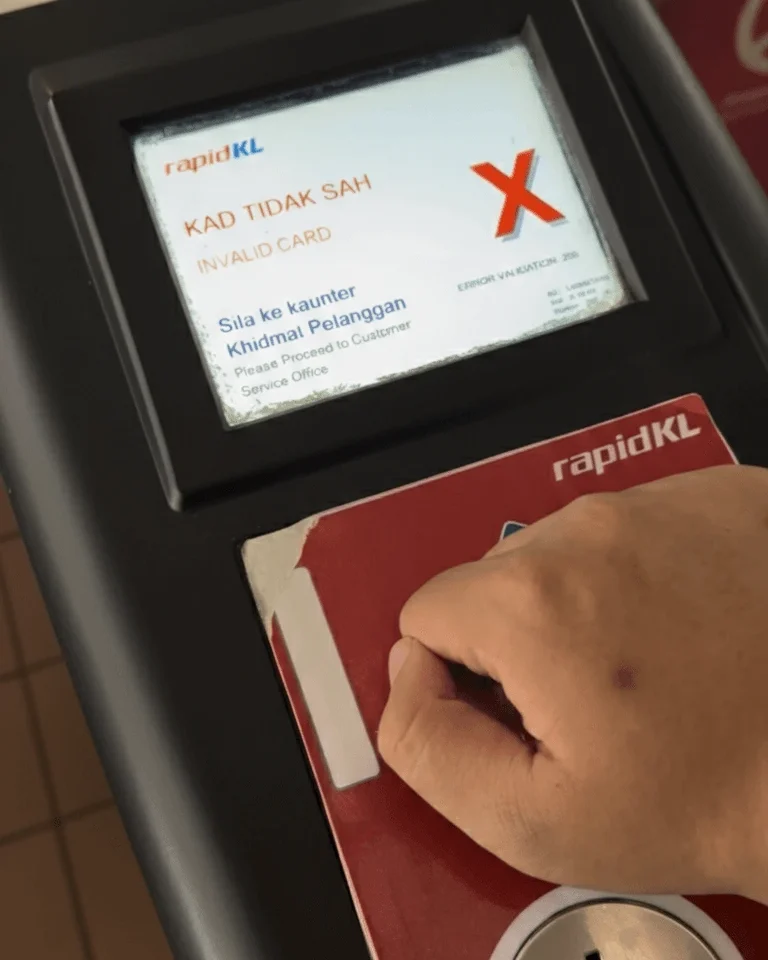
Seeing “Invalid Card” at LRT gates while using your TNG NFC Ring? Here’s why it happens, how NFC detection works in Malaysia, and how proper antenna tuning improves tap stability.
If you commute daily using LRT in Malaysia and you’re using a TNG NFC Ring, you may have seen this message before:
Invalid Card. Please proceed to counter.
And instantly, panic mode activated.
Is my TNG NFC Ring not working?
Is it blocked?
Did the system reject it?
Relax.
Most of the time, your TNG NFC Ring is not invalid.
Let’s break down what’s really happening at LRT gates operated by Rapid KL, including lines like LRT Ampang Line and LRT Kelana Jaya Line.
How TNG NFC Ring Works at LRT Gates
Your TNG NFC Ring uses NFC technology operating at 13.56MHz (ISO14443 standard) the same frequency used by transit systems in Malaysia.
When you tap your TNG NFC Ring:
- The reader emits a magnetic field
- The ring’s antenna gets powered wirelessly
- The system reads the unique chip ID
- Backend verification happens
- The gate opens
This entire process happens in milliseconds.
But if the handshake between reader and ring fails even briefly, the system may display:
“Invalid Card”
Even when your TNG NFC Ring is functioning properly.
Why “Invalid Card” Can Appear When Using TNG NFC Ring
1️⃣ Weak NFC Coupling (Positioning Issue)
NFC relies on magnetic field coupling.
If:
The ring is tapped too quickly
The finger positioning is slightly off
The ring is too far from the reader surface
The tap angle is inconsistent
The reader may fail to complete authentication.
Older systems may instantly show “Invalid Card” instead of prompting a retry.
It’s not rejection.
It’s incomplete signal detection.
2️⃣ Older LRT Reader Hardware
Some stations may still use older reader hardware with:
Narrow timing windows
Lower antenna sensitivity
Limited retry logic
If the NFC handshake isn’t completed smoothly, the reader defaults to an error message.
This behavior is system-driven, not device-specific.
3️⃣ Peak Hour Traffic Load
During rush hour:
Thousands of NFC taps per minute
Heavy backend validation
High system load
If authentication timing is interrupted, the gate may return a generic error.
Again… this does not automatically mean your TNG NFC Ring is invalid.
Does Ring Size Affect Detection?
This is a common myth:
“A ring is smaller than a card, so it must be harder to detect.”
Not true.
NFC performance depends on:
Proper antenna tuning
Accurate resonance at 13.56MHz
Coil design efficiency
Stable positioning during tap
Your TNG NFC Ring is engineered with a tuned circular antenna optimized for close-range magnetic coupling.
Detection stability depends on signal quality. Not physical shape.
Why Antenna Design Matters More Than Form Factor
A well-designed NFC ring:
Maintains consistent antenna alignment
Avoids wallet bending damage
Reduces antenna wear from daily flex
Keeps coil structure stable over time
Unlike flat cards that may bend inside wallets, the TNG NFC Ring maintains structural integrity when worn properly.
Stable structure = consistent coupling.
✅ What To Do If You See “Invalid Card” With TNG NFC Ring
Before heading to the counter:
✔ Tap again slowly
✔ Hold your finger steady for half a second
✔ Ensure the ring touches the reader surface directly
✔ Avoid stacking your hand with other NFC cards nearby
In most cases, a second steady tap works instantly.
The Future of Transit Tapping in Malaysia
NFC technology is evolving.
Wearable NFC devices like the TNG NFC Ring offer:
Hands-free convenience
Reduced physical wear
Consistent antenna positioning
Compact and modern form factor
Detection reliability depends on tuning and technique, not just device size.
Understanding how NFC works removes unnecessary panic when you see “Invalid Card.”
Sometimes the system just needs a cleaner signal.